Now think of PPC advertising as your express pass. Instead of waiting months for SEO results, you get seen immediately. With the right approach, your ad appears when someone is ready to buy. This pay-per-click model means you only pay when someone actually clicks your ad — making every dollar accountable. That speed and precision are what make PPC so valuable.
In this guide, you’ll learn everything you need to run smarter campaigns. We’ll cover different platforms, show proven PPC strategies, and explain how to track real ROI. You’ll also see how PPC works in practice, so every dollar spent brings measurable results.
The Core of PPC: Breaking Down the Basics
You don’t need fancy tools or advanced tricks to start. What matters first is understanding the basics. PPC isn’t as complicated as it looks. Once you see how it really works, the rest feels a lot easier.
What is PPC Advertising?
What is PPC, or pay-per-click, is simple. You only pay when someone clicks your ad. Unlike a billboard or magazine spot, you don’t pay for empty views. Think of it as a digital auction house. Advertisers place bids, and the most relevant, high-quality ad wins a spot.

For a step-by-step walk-through on launching your first campaign, check out How to Set Up an Effective PPC Campaign.
Why Businesses Invest in PPC
Organic marketing is important, but it moves slowly. Ranking in search results often takes months. PPC delivers visibility the moment you launch. Another advantage is control. You decide the budget, the audience, and the message. That flexibility is why small shops and global brands both trust PPC.
How PPC Advertising Works
Here’s the process, step by step:
- Advertiser sets a bid for a keyword.
- User types the keyword in a search engine.
- An auction happens instantly in the background.
- The winning ad shows up in search results.
- Each click reduces the advertiser’s budget.
Exploring PPC Platforms
Not all clicks come from the same place. Each platform has its own crowd, its own style, and its own way of getting people to notice your brand. Knowing where your audience spends time is half the battle. Pick the right stage, and your ads won’t just be seen — they’ll connect.
The Big Names in PPC
Each platform has its own personality, strengths, and quirks. Understanding how they differ helps you choose the right stage for your ads and avoid wasting budget where your audience isn’t looking.
Google Ads
This is the heavyweight. When people search, they usually start here. If someone’s typing “best running shoes near me,” Google puts you in front of them at the perfect moment. It’s powerful, but competitive, so clicks often cost more.
Microsoft Ads (Bing)
Think of Bing as Google’s quieter cousin. It doesn’t get as much attention, but the audience is solid—often older, with higher spending power. Costs are lower, and competition is lighter. That means better value if your buyers fit the profile.
Meta Ads (Facebook + Instagram)
These ads excel at finding people based on who they are, not just what they search. From interests to lifestyle habits, the targeting is sharp. Here, creativity is everything. Bright visuals and scroll-stopping content win.
LinkedIn Ads
If your customers wear suits instead of sneakers, LinkedIn is your arena. You can target by job title, industry, or even company size. It’s pricey compared to other platforms, but the quality of leads often makes up for it.
TikTok & Pinterest Ads
TikTok is the playground for younger, creative audiences. Quick, engaging videos rule here. Pinterest, on the other hand, feels more like a visual catalog. It’s perfect for lifestyle, fashion, or home brands. Both platforms reward businesses that lean into visual storytelling.
Quick Overview of PPC Platforms
| Platform | Best For | Average CPC | Audience Targeting Strength | Creative Format |
| Google Ads | Search intent, broad reach | High | Strong keyword targeting | Text + Shopping |
| Microsoft Ads | Older, professional audience | Medium | Niche targeting | Text |
| Meta Ads | Demographics + interests | Medium | Advanced AI targeting | Visual-heavy |
| LinkedIn Ads | B2B campaigns | High | Job title/industry | Sponsored posts |
| TikTok Ads | Younger, creative demographics | Low–Medium | Interest-based | Short-form video |
| Pinterest Ads | Lifestyle + shopping inspiration | Medium | Behavior-based | Pins + Shopping |
Crafting Winning Pay-Per-Click Strategies
Now that you know where the ads live, the next step is learning how to make them work. It’s not about who spends the most. It’s about who spends the smartest. Strong pay-per-click strategies keep your budget safe while still pulling in the right clicks.
Know Your Audience First
Start with the people. Who are they? What keeps them up at night? What words do they type when looking for answers? Build a picture of your ideal buyer before you launch a single ad. When you know their habits and pain points, your ads feel less like noise and more like help.
Smart Budget Allocation
Budgets decide how far your ads can run. Daily budgets are steady and easy to manage, while lifetime budgets are perfect for short, intense bursts. Don’t pour everything into one bucket. Keep part of your spend on awareness and the rest on driving sales. That mix keeps your funnel healthy.
Planning budgets around seasons? Don’t let your ad spend go to waste. Check out our guide on seasonal PPC strategies to make every holiday click count.
Ad Copy and Creative Optimization
An ad has seconds to win attention. Strong headlines, clear benefits, and urgency make people stop scrolling. Show why your offer matters right now. On visual platforms, looks matter. Crisp photos, sharp graphics, and short videos perform far better than walls of text.
Testing and Iterating
Think of PPC as a constant experiment. Test headlines against each other. Swap images. Try a new call-to-action. Some ads will flop, and that’s fine. The key is cutting losers fast and doubling down on what works. The more you test, the cheaper your conversions get over time.
The Secret Sauce: Understanding Ad Auctions
Every PPC ad you see has already won a fight. Behind the scenes, there’s a lightning-fast auction happening every time someone searches. If you want your ad to show up, you need to understand how those auctions work.
The Role of Keywords
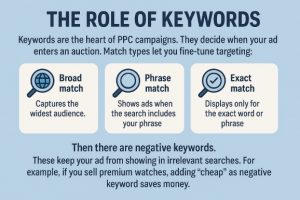
Keywords are the heart of PPC campaigns. They decide when your ad enters an auction. Match types let you fine-tune targeting:
- Broad match: Captures the widest audience.
- Phrase match: Shows ads when the search includes your phrase.
- Exact match: Displays only for the exact word or phrase.
Then there are negative keywords. These keep your ad from showing in irrelevant searches. For example, if you sell premium watches, adding “cheap” as a negative keyword saves money.
For a deeper dive into keyword targeting, see Keyword Match Types in PPC: Broad v. Phrase v. Exact.
Quality Score Demystified
Google doesn’t just look at your bid; it looks at your ad quality. The Quality Score is based on:
- Click-through rate (CTR)
- Relevance of your ad
- Landing page experience
A high score lowers your cost per click. A poor score means you’ll pay more, even if your bid is higher.
How PPC Advertising Works in Auctions
Your ad rank is not just about money. It’s your bid multiplied by your Quality Score.
| Advertiser | Max Bid | Quality Score | Ad Rank |
| A | $5 | 10 | 50 |
| B | $8 | 6 | 48 |
| C | $10 | 4 | 40 |
Here, Advertiser A spends less but still wins the top spot.
Tracking ROI in PPC Campaigns
Clicks don’t pay the bills. Results do. To know if your campaigns are working, you need to measure what matters. ROI tracking is what turns numbers into insights and spend into strategy.
Key Metrics that Matter
There are a few benchmarks every advertiser should watch:
- CTR (Click-Through Rate): How many people click your ad.
- CPC (Cost Per Click): What you’re paying for each click.
- CPA (Cost Per Acquisition): How much it costs to land a customer.
- ROAS (Return on Ad Spend): The revenue earned per dollar spent.

Don’t forget Lifetime Value (LTV). A customer who buys once may not justify a high CPA, but one who buys five times over the year might be worth every penny.
Attribution Models Explained
Attribution decides which ad gets credit for a sale:
- First-click: The ad that started the journey.
- Last-click: The ad that sealed the deal.
- Linear: Every touchpoint shares the credit equally.
- Data-driven: Uses machine learning to weigh each step’s impact.
Choosing the right model depends on your goals. For brand awareness, first-click matters. For closing sales, last-click might be more useful.
ROI Table Example
| Metric | Campaign A | Campaign B | Campaign C |
| Spend | $2,000 | $5,000 | $3,500 |
| Conversions | 200 | 350 | 180 |
| CPA | $10 | $14.28 | $19.44 |
| ROAS | 4.5x | 3.2x | 2.8x |
Looking at this table, Campaign A is the clear winner. Lower CPA and higher ROAS show it’s bringing in the best return.
Not sure which ad type fits your goals? Discover the pros and cons of each format in our guide on Search vs. Display Ads: What Works Better for Leads. This will help you choose the right strategy for maximum ROI.
Common Mistakes in PPC & How to Avoid Them
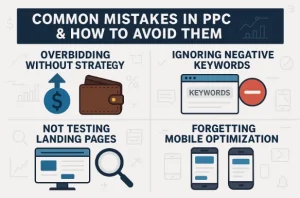
PPC can be a money machine or a money pit. The difference comes down to how you steer it. A few missteps can drain your budget faster than you can say “click-through rate.” Here are the mistakes that trip up most advertisers — and how to dodge them.
Overbidding without Strategy
Many brands think, “If I just outbid everyone, I’ll win.” Wrong. It’s like paying double for a front-row seat when the show looks just as good from the middle. Overbidding empties your wallet without guaranteeing more sales. The trick isn’t spending the most — it’s spending the smartest.
Ignoring Negative Keywords
Ever clicked on something and thought, “This isn’t what I wanted at all”? That’s exactly what happens when you skip negative keywords. Without them, you’re paying for clicks from people who will never buy. A simple list of “no-go” terms — like “free,” “jobs,” or “DIY” — keeps your budget safe and focused on real prospects. Skipping this step is one of the key reasons many PPC campaigns fail, leading to wasted spend and poor results.
Not Testing Landing Pages
Think of your ad as a promise. If the landing page breaks that promise, visitors bounce. A polished ad won’t save a clunky form or confusing layout. Test small tweaks — headlines, button colors, even the length of your form. Sometimes the tiniest change can turn browsers into buyers.
Forgetting Mobile Optimization
Half your traffic (or more) is on mobile. If your site takes forever to load or the design pinches into unreadable text, people won’t wait. They’ll leave. Mobile optimization isn’t a “nice to have” — it’s survival. Clean, fast, finger-friendly pages win every time.
Advanced Pay-Per-Click Strategies for Growth
Once you’ve nailed the basics, PPC can do more than just keep sales steady — it can fuel growth. The secret lies in smarter PPC strategies that go beyond clicks and into customer connections. Today, you can even use AI tools to optimize campaigns, refine targeting, and get data-driven insights that make every ad more effective.
Dynamic Search Ads and Smart Campaigns
Picture having an assistant who studies your website and automatically matches your ads to the right searches. That’s what Dynamic Search Ads do. Add Smart Campaigns to the mix, and your ads learn on the fly — capturing opportunities you’d never spot manually.
Remarketing and Retargeting
Here’s the truth: most people don’t buy the first time. Remarketing is your friendly reminder.
- Segmenting warm audiences: Treat shoppers differently. Cart abandoners need a gentle nudge; repeat visitors may need a sweet deal.
- Creative retargeting examples: “Still thinking it over?” ads with a discount. Or showing a product ad after someone reads your blog post about the problem it solves.
Done right, it feels like a personal follow-up, not a pushy salesman.
Leveraging AI and Automation
AI isn’t replacing you; it’s freeing you.
- Smart bidding strategies: Let the platform chase conversions while you focus on strategy.
- Responsive search ads: Give Google multiple headlines and descriptions; it tests combinations until it finds the winners.
Think of it as having a tireless assistant, running experiments 24/7, while you steer the bigger picture.
Cross-channel Integration
PPC works best when it’s part of the bigger plan.
- PPC + SEO synergy: Ads get you seen right now. SEO builds trust long-term. Together, they’re unstoppable.
- PPC fueling email and content campaigns: Run ads to capture leads, then nurture them with content and emails until they’re ready to buy.
When your channels connect, your brand feels everywhere. And that’s how you turn clicks into loyal customers.
When it comes to writing ad copy, leverage AI to your advantage. Our guide on Using ChatGPT and AI for PPC Copywriting explores how artificial intelligence can generate fresh ideas, craft persuasive messaging, and boost click-through rates.
How PPC Advertising Works in the Real World
PPC is a lot like running a small shop. You don’t just hang a sign and walk away — you open the doors, watch who comes in, and make changes until things click.
More Read: Local PPC Advertising: Effective Geo-Targeting Strategies
Here’s how it usually plays out:
Setup → Launch → Data Collection → Optimization → Scale
- Setup: You set a clear goal. More calls? More sales? More sign-ups? That choice shapes everything.
- Launch: Ads go live. At this stage, you’re just testing the waters.
- Data Collection: Every click tells you something. Sometimes it’s good news, sometimes it stings — but the feedback is gold.
- Optimization: Now you fine-tune. Cut weak ads, adjust bids, and sharpen your targeting.
- Scale: Once the formula is working, you put more budget behind it and grow.

That’s how PPC works when you strip it down. It’s not about luck; it’s about paying attention, making steady tweaks, and letting the numbers guide your hand.
Future of PPC Advertising
The PPC world never stays still. What worked two years ago may not land tomorrow. Here’s what’s shaping the future:
Privacy and Cookieless Tracking
Third-party cookies are fading fast. Businesses will lean on their own data, like customer emails and loyalty programs, to keep ads personal without crossing lines.
Rise of AI-driven Ads
AI is taking over the heavy lifting. It can adjust bids on the fly, write multiple ad versions, and spot patterns humans miss. It’s like having an extra set of eyes that never gets tired. For eCommerce brands, choosing between Google Ads and Facebook Ads can shape results, as it depends on where your audience is most active.
Voice Search and Visual Shopping
People are talking to their devices more than ever. “Hey Siri, best plumber near me” is now a search. At the same time, visual shopping, or buying straight from an image, is booming. PPC will follow where people spend their attention.
The winners won’t be the ones with the deepest pockets. They’ll be the ones who adapt quickest.
Final Takeaways
PPC is simple at its core: you pay for clicks and turn them into results. But the secret isn’t in launching; it’s in testing, refining, and scaling at the right time.
We’ve covered smart pay-per-click strategies and walked through how PPC advertising works in practice. The truth is, campaigns rarely start perfectly. They grow stronger with every test and every adjustment.
So, here’s your takeaway: don’t just set ads and forget them. Audit your campaigns, experiment with new platforms, and keep tweaking until you find the sweet spot.
Because the next big win for your business isn’t months away — it might be hiding in the campaign you’re already running today.
Looking for expert guidance? Salman Yousuf can help you plan, launch, and optimize PPC campaigns that actually deliver ROI. Let’s turn your ad spend into measurable growth.
Frequently Asked Questions
1. Is PPC worth it for small businesses?
Absolutely. PPC gives small businesses a chance to show up alongside big brands. With smart targeting and a modest budget, you can drive local traffic, boost sales, and grow visibility without overspending. It levels the playing field.
2. How long does it take to see PPC results?
Clicks can come within hours, but real success takes testing. Expect two to four weeks of refining keywords, ads, and bids before results stabilize.
3. What’s the biggest mistake people make with PPC?
Overspending too soon. Many chase traffic without checking conversions. Always test ads, refine targeting, and track metrics before scaling up your budget.
4. Do I need a big budget to run PPC ads?
No. You can start with just $10–$20 daily. Strategy, not spend, decides success.
5. Can PPC replace SEO completely?
Not really. PPC works fast, but SEO builds trust and authority over time. Together, they deliver both quick wins and steady growth.