When travelers search for a hotel, they often meet Google before they meet your website.
Searches such as “hotels near me,” “hotels in Miami,” or “pet-friendly hotels near downtown” can surface hotel information directly across Google Search and Maps. Travelers can compare locations, reviews, photos, amenities, rates, and other details before deciding which properties deserve a closer look.
That makes your Google Business Profile an important part of hotel SEO.
Hotels that optimize Google My Business profiles for local SEO should focus on more than adding a few keywords. Accurate property information, hotel-specific attributes, reviews, visual content, booking information, and a locally optimized website should work together.
Here are 10 practical ways to improve your hotel’s profile.
1. Claim and Verify Your Hotel Business Profile
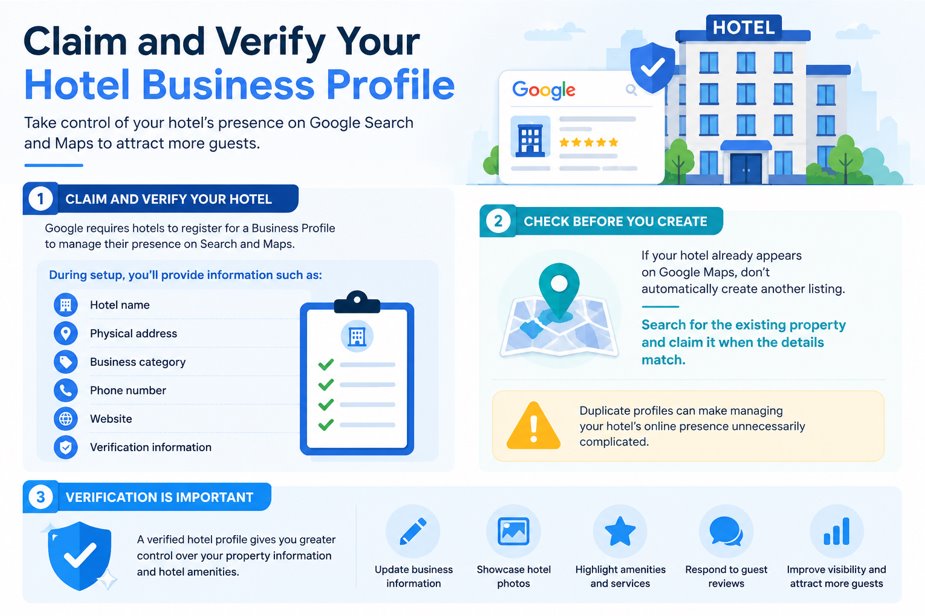
Start by making sure your hotel is claimed and verified.
Google requires hotels to register for a Business Profile to manage their presence on Search and Maps. During setup, you’ll provide information such as your:
- Hotel name
- Physical address
- Business category
- Phone number
- Website
- Verification information
If your hotel already appears on Google Maps, don’t automatically create another listing. Search for the existing property and claim it when the details match.
Duplicate profiles can make managing your hotel’s online presence unnecessarily complicated.
Verification is particularly important because a verified hotel profile gives you greater control over property information and hotel amenities.
2. Keep Your Hotel’s Core Information Accurate
Local SEO starts with accurate information.
Your hotel’s Business Profile should match the real-world property and the information displayed on your official website.
Check your:
- Hotel name
- Street address
- Map location
- Phone number
- Website URL
- Property details
For hotels, location accuracy is especially important.
A traveler using Google Maps may rely on the map pin to reach the property after arriving in an unfamiliar city. A misplaced pin or incorrect address is therefore more than an SEO problem—it creates a poor guest experience.
Review your profile periodically and immediately correct important information after a rebrand, phone number change, website migration, or other major update.
3. Choose the Most Accurate Hotel Category
Your primary category helps Google understand what type of lodging property you operate.
Don’t simply choose a broad category if a more accurate option describes the property.
Depending on the accommodation, an appropriate category might describe the property as a:
- Hotel
- Motel
- Hostel
- Resort hotel
- Extended stay hotel
- Bed and breakfast
Only select categories that genuinely represent the business.
Google explains that relevance is one of the main factors used in local ranking. Providing complete and detailed business information helps Google understand the business and match it with relevant searches.
Think about categories as classification rather than a place to insert SEO keywords.
4. Complete Your Hotel Amenities and Attributes
This is where hotel optimization differs significantly from optimizing many other local businesses.
Google provides hotel-specific details and amenities that potential guests can view in Search and Maps.
Depending on your property, relevant information could include:
- Free Wi-Fi
- Parking
- Swimming pool
- Pet-friendly accommodation
- Fitness facilities
- Restaurant
- Accessibility features
- Sustainability practices
- Other available property amenities
Google can also display hotel highlights, such as Free Wi-Fi, Free Parking, or Pet Friendly, when applicable.
Review these details carefully.
Imagine someone specifically looking for a pet-friendly hotel. Your property allows pets, but your Google information doesn’t accurately reflect that amenity.
You have made it harder for that traveler to understand that your hotel fits their needs.
Hotel attributes aren’t fields to fill for the sake of SEO. They help travelers evaluate whether your property matches their requirements.

5. Upload Photos That Help Travelers Choose
Hotel purchases are highly visual.
Potential guests want to see what the property actually looks like before booking.
Build a useful collection of high-quality, current images covering areas such as:
- Exterior and entrance
- Lobby
- Guest rooms
- Bathrooms
- Restaurants and breakfast areas
- Pool
- Fitness facilities
- Meeting spaces
- Parking
- Views
- Property amenities
Avoid relying entirely on highly polished promotional photographs.
Professional photography is valuable, but travelers also want an accurate impression of what they’ll experience when they arrive.
Replace outdated photos after renovations and add new images when rooms or common areas change.
The goal should be simple: reduce uncertainty before booking.
Turn Local Hotel Searches Into More Bookings
A complete Google Business Profile is only one part of hotel search visibility. Your profile, website, reviews, local SEO, and conversion strategy need to support the same customer journey.
Work with Salman Yousuf to build a data-driven local SEO strategy designed to increase hotel visibility, attract qualified travelers, and turn more searches into direct opportunities.
6. Build a Consistent Google Review Strategy
Reviews play two important roles for hotels: visibility and trust.
Google states that review count and positive ratings can contribute to local ranking. Reviews also help travelers evaluate real guest experiences before making a booking decision.
Create a simple process for requesting reviews from genuine guests after their stays.
You might include review requests in:
- Post-stay emails
- Checkout communications
- Guest feedback workflows
- QR codes provided at appropriate touchpoints
Never offer discounts, free stays, upgrades, or other incentives in exchange for Google reviews. Google prohibits incentives in exchange for reviews.
You should also respond to feedback.
For a positive review, thank the guest and make the response relevant to their experience.
For a negative review, avoid becoming defensive. Acknowledge the concern professionally and move sensitive or complicated issues into a private conversation when appropriate.
Remember that your response isn’t only for the reviewer. Future guests will read it too.
7. Check Your Rates and Booking Links
For hotels, Business Profile optimization extends into the booking journey.
Google explains that hotel prices and booking links can appear on hotel profiles through Google Hotel Ads and free booking links.
This creates an important opportunity.
A traveler may discover your hotel, compare its reviews and amenities, check pricing, and move toward booking without following the same journey as a traditional organic website visitor.
Hotel owners should therefore make sure their property information is correctly matched and that their rate and availability setup is accurate when using Google’s hotel booking ecosystem.
Where available, direct booking visibility can also help create a clearer path from Google to your hotel’s own booking experience.
This is one reason hotel GBP optimization should not be measured only through website traffic.
Bookings matter more than clicks.
8. Optimize Your Hotel Website for Local Search
Your Business Profile should not operate separately from your website.
Google says prominence can be influenced by information it knows about a business from across the web, including links. Google also notes that organic web ranking is a factor in local search, meaning traditional SEO best practices still matter.
Your hotel website should clearly communicate:
- Hotel name
- Address and location
- Phone number
- Accommodation options
- Amenities
- Nearby attractions
- Booking information
- Directions
- Relevant destination information
You can also create genuinely useful local content.
For example:
- Things to Do Near the Hotel
- Restaurants Within Walking Distance
- How to Get From the Airport to the Hotel
- Best Attractions Near the Property
- Business Travel Guide to the Area
This content helps potential guests plan their stay while strengthening the website’s connection with its destination.
Avoid creating thin pages that simply repeat a city keyword.
Create content a traveler could actually use.
9. Strengthen Your Hotel’s Prominence Beyond GBP
You cannot fully optimize local SEO from inside Google Business Profile.
Google’s local ranking framework includes prominence, which reflects how well-known a business is. Google says this can draw on information such as links, articles, directories, and reviews.
For hotels, broader local authority can come from legitimate sources such as:
- Tourism organizations
- Local publications
- Travel publications
- Event websites
- Local business associations
- Relevant directories
- Partnerships with nearby attractions
- Quality editorial coverage
For example, a local tourism website mentioning your hotel in a useful accommodation guide provides a different kind of signal than creating dozens of low-quality directory listings.
Focus on building genuine local visibility rather than accumulating links simply to increase a number in an SEO tool.
10. Measure Actions That Matter to Hotel Revenue
Local SEO reporting should go beyond profile views.
Pay attention to actions that indicate genuine traveler interest.
Depending on the Google features and tracking available to your hotel, evaluate:
| Metric | Why It Matters |
|---|---|
| Website visits | Shows movement from Google to your property site |
| Calls | Indicates high-intent guest interest |
| Directions | Can reflect interest in reaching the property |
| Reviews | Shows reputation growth and guest engagement |
| Booking activity | Connects visibility with revenue opportunities |
| Search queries | Helps reveal how travelers discover the hotel |
Use UTM parameters where appropriate on links you control so analytics platforms can better distinguish traffic originating from your Business Profile or campaigns.
Then look at the full journey.
If visibility is increasing but direct booking activity isn’t, investigate the next step. The issue could be pricing, weak room pages, poor mobile usability, unclear booking options, outdated photography, or another conversion barrier.
Local SEO should ultimately support occupancy and revenue—not vanity metrics.
Common Hotel Google Business Profile Mistakes
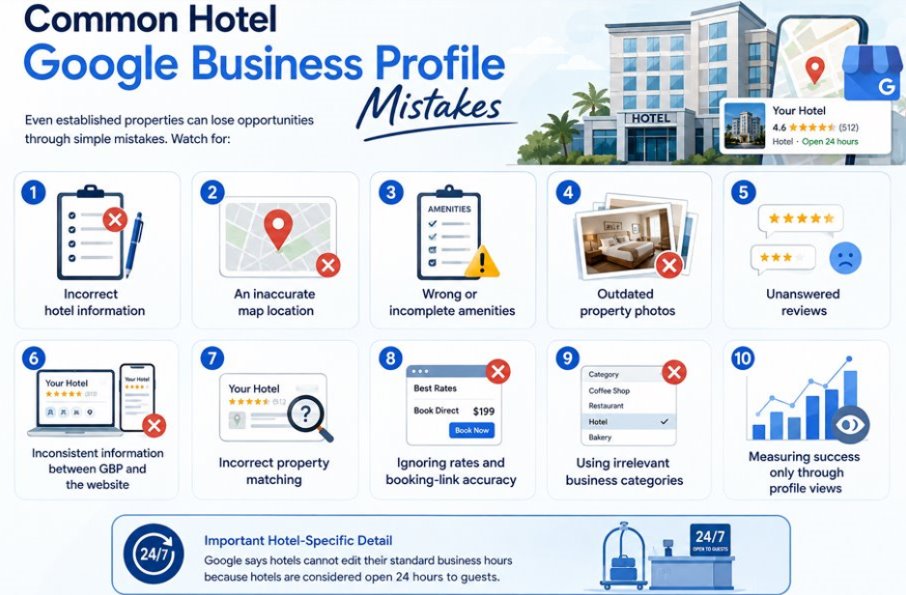
Even established properties can lose opportunities through simple mistakes.
Watch for:
- Incorrect hotel information
- An inaccurate map location
- Wrong or incomplete amenities
- Outdated property photos
- Unanswered reviews
- Inconsistent information between GBP and the website
- Incorrect property matching
- Ignoring rates and booking-link accuracy
- Using irrelevant business categories
- Measuring success only through profile views
There is also an important hotel-specific detail: Google says hotels cannot edit their standard business hours because hotels are considered open 24 hours to guests.
That’s exactly why hotels shouldn’t blindly follow generic GBP optimization checklists written for restaurants, retailers, or service businesses.
FAQs About Hotel Google Business Profile SEO
How can hotels optimize Google My Business profiles for local SEO?
Hotels should verify their profiles, maintain accurate property information, select the correct category, complete hotel amenities, upload current photos, earn genuine guest reviews, monitor booking information, and support the profile with a locally optimized website.
Do Google reviews help hotel local SEO?
Yes. Google states that review count and positive ratings can contribute to local ranking. Reviews also help travelers compare hotels and assess the quality of previous guest experiences.
How often should a hotel update its Google Business Profile?
Review the profile regularly and update information whenever something changes. Pay particular attention after renovations, amenity changes, rebranding, contact-detail changes, or major updates to the property.
Can hotels add booking links to Google?
Google can display hotel prices and booking links through its hotel ecosystem, including Google Hotel Ads and free booking links. Hotels should ensure their property, rates, availability, and booking information are properly connected and accurate.
What are the main Google local ranking factors for hotels?
Google says local results are mainly based on relevance, distance, and prominence. Hotels can strengthen relevance and prominence through complete business information, reviews, website SEO, links, accurate hotel details, and a strong online presence, but they cannot control a searcher’s physical distance from the property.
Conclusion
Hotels that optimize Google My Business profiles for local SEO have an opportunity to improve how their properties are presented when travelers search across Google Search and Maps.
Start with the fundamentals: claim and verify the profile, maintain accurate property information, choose the right category, complete hotel amenities, add useful photos, and build a consistent review strategy.
Then go beyond the profile.
Connect your GBP with strong hotel website SEO, useful destination content, accurate booking information, local authority, and measurable conversion tracking.
For hotels, the goal isn’t simply to appear on Google Maps. It’s to make your property easier to discover, easier to trust, and easier to book.
Want to turn more local and destination searches into hotel bookings? Connect with Salman Yousuf for a local SEO and Google Business Profile strategy focused on visibility, trust, and measurable growth.